- calendar_today August 16, 2025
.
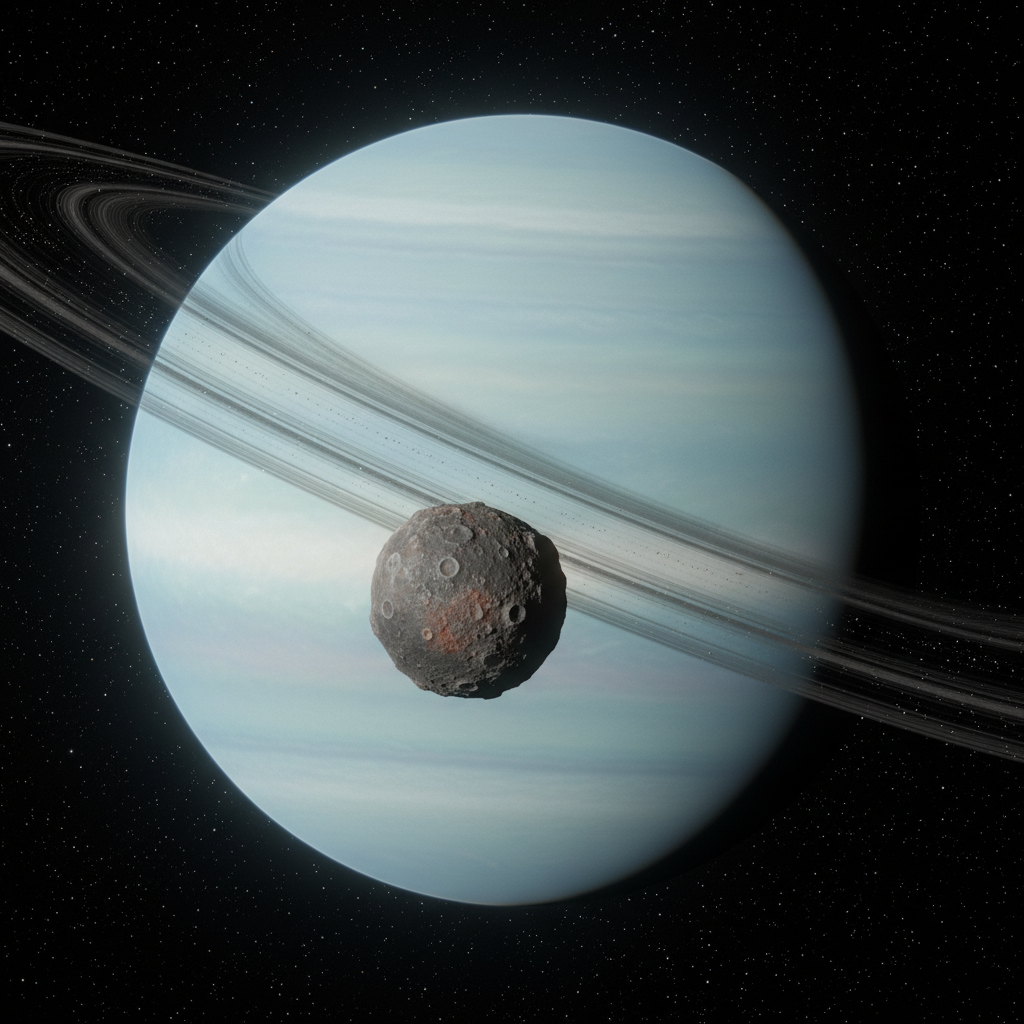
The James Webb Space Telescope has detected a previously unseen moon around Uranus, an ice giant that is known for its weird rings and tilted rotation. The discovery adds another moon to Uranus’ already large collection of inner satellites. It’s the 29th known moon of the planet, and scientists expect more to lurk undetected.
Webb spotted the faint object on Feb. 2 during a sequence of 40-minute long-exposure images. The new satellite is only 6 miles (10 km) across. The moon’s diminutive size and dark color were likely too faint to be spotted against the bright glare of Uranus’ rings by previous space missions and telescopes from the ground. The moon was even too small to be detected by NASA’s Voyager 2 spacecraft when it flew by Uranus nearly 40 years ago.
“This is a small moon but a significant discovery,” said Maryame El Moutamid, a principal investigator in the Southwest Research Institute’s Solar System Science and Exploration Division in Boulder, Colorado. El Moutamid, lead scientist on a Webb program dedicated to studying Uranus’ rings and inner moons, said the find also shows how Webb is helping to push knowledge of the solar system even beyond previous missions.
Dubbed S/2025 U1, the newfound moon orbits about 35,000 miles (56,000 km) from the center of Uranus. It orbits near the equator of the planet and has a nearly circular orbit, moving between the two known moons, Ophelia, just outside Uranus’ main ring system, and Bianca. The orbit is consistent with it having formed in its current location.
But before astronomers were able to lock onto its orbit, they first had to tease the moon out from the glare of Uranus and its ring system. The satellite is both dark, tiny and moves very quickly. That’s where Webb came in, sensitive enough to spot its faint infrared light, adding to discoveries already made by the telescope of Uranus’ rings, weather, and atmosphere.
A Closer Look at Uranus
The moon’s detection not only gives scientists another satellite around Uranus to puzzle out how it fits into the planet’s evolution. The moon’s discovery also hints at the origins of Uranus’s own ring system, which likely formed alongside the satellites. The moon and the planet’s rings and gaps likely share a history, El Moutamid said. “The discovery raises questions about how many more small moons remain hidden around Uranus and how they interact with its rings,” she said.
In addition to five major moons that orbit Uranus — Miranda, Ariel, Umbriel, Titania, and Oberon — the planet has several smaller satellites as well. S/2025 U1, this new satellite becomes the 14th small moon found orbiting in the inner system. No other planet has as many small inner moons that are clustered so closely together, El Moutamid said. The moons are also so close together that their orbits cross one another. But somehow they’re stable. The moons may also shepherd Uranus’ narrow rings.
“This is very exciting!” said Scott Sheppard, an astronomer at the Carnegie Institution for Science who was not involved in the new study but co-discovered a Uranus moon in 2024. “The association with the inner ring system of Uranus makes it especially interesting.” Webb is sensitive enough to detect the moon because it’s moving so quickly, Sheppard said. “These are the types of things that would have been impossible without Webb.”
SETI Institute planetary scientist Matthew Tiscareno, also a co-principal investigator in the Webb Uranus project, said the detection was a “goldilocks discovery,” both big enough and close enough to Uranus’ rings to be discovered, but still very small and faint. The line between the planet’s moons and its rings is more blurred than scientists think, Tiscareno added. “The complex inter-relationships between all of these objects hint at a chaotic history that is ongoing,” he said. S/2025 U1, this newly discovered satellite, is even fainter and smaller than the smallest known Uranian inner moons, so it’s likely not the last.
Future Missions to Uranus
Looking ahead, the potential for future exploration of Uranus is on the horizon. A planetary decadal survey released by the National Academies of Sciences, Engineering, and Medicine last year recommended the Uranus Orbiter and Probe mission as the next large planetary project for NASA. The mission could launch in the early 2030s, though funding is uncertain as NASA and Congress debate their budgets for the next decade. The mission would look into Uranus’ strange rotation, bizarre magnetic field, atmospheric dynamics, and potentially icy ocean worlds that may exist in the planet’s moons.
Sheppard expects that there are many more moons as small as a few kilometers in diameter to be found orbiting the planet and are waiting to be discovered either in long-exposure Webb images or by spacecraft that visit the distant solar system in the future. El Moutamid and her team hope to confirm the orbit of S/2025 U1 and find more hidden satellites with Webb.
“Discovering a new moon around Uranus helps scientists better understand how this strange system formed, sheds light on its rings, and prepares us for future missions like NASA’s Uranus Orbiter and Probe,” El Moutamid said.